- September 14, 2026
- Construction,Design,Mini Golf,
- Tracey
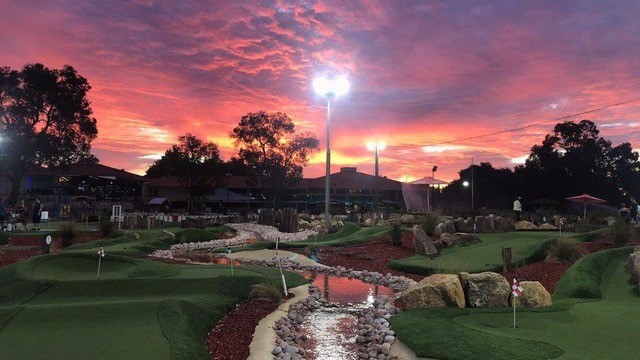
A lit mini golf course lets a venue keep trading after sunset, and the evening crowd is a different market to the daytime one. Couples, work groups and social bookings replace the family trade, they stay longer, and they spend at the bar and kitchen on the way through. Getting there takes lighting designed into the course from the start rather than added afterwards, along with council approval covering trading hours, light spill and noise.
Most operators think of mini golf as a daytime attraction because that is how it usually opens. The families arrive in the middle of the day, the course is busy through the school holidays, and it sits dark from five o’clock onwards. That is half a trading day going unused through the best part of the year.
Why does mini golf work after dark?
Warm evenings are when people actually want to be outside. Through the middle of summer the afternoon is too hot to enjoy a round, and the comfortable window opens around six. A course that can trade until nine or ten captures that window instead of closing into it.
From the first Sunday in October, New South Wales, Victoria, South Australia, Tasmania and the ACT move to daylight saving, which hands venues in those states an extra hour of usable light on a spring evening. Queensland does not, so Queensland operators lean on course lighting earlier in the season to get the same result.
Who plays mini golf at night?
The evening audience skews adult. Couples on a first or second date use it because it gives two people something to do while they talk, which takes the pressure off a dinner table. Work teams book it after hours because everybody can play without a lesson or a handicap. Groups of friends book it because it fills the gap between a drink and a meal.
Those groups behave differently to a family at two in the afternoon. They arrive later, they stay longer, and they are already in spending mode. Our article on corporate event bookings covers the same dynamic on the function side of the business.
What does an evening trade do to the revenue picture?
The clearest gain is trading hours. Adding three hours to the end of the day through the warm season is a substantial lift on the same asset, with no change to the build and only a modest change to staffing.
The second gain sits behind the bar. An adult group playing at seven will usually order before, during or after the round, and a course close to the venue’s food and drink puts them in front of it twice. Our revenue calculator lets you model longer opening hours against your own average ticket to see what those extra hours are worth at your site.
What does the course need for night play?
Lighting has to be designed with the layout rather than hung above it once the course is finished. Players need to read a slope, follow the ball and walk between holes safely, and that means light placed for the line of play instead of spread evenly across the site. Glare across a putting surface will ruin a hole that plays perfectly in daylight.
Power runs, cable routes and fixture footings all sit under the course, which is why the decision belongs in the design stage. Our design and process page sets out where that conversation fits, and if you are weighing up course size at the same time, our guide on nine holes against eighteen is worth a read alongside it.
What do you need to sort out with council?
Extended trading hours, outdoor lighting and noise are the three conditions that usually sit on an approval for evening play. Light spill onto neighbouring properties is the one that catches operators out, particularly on sites backing residential land. Lighting also has to meet the requirements applying to the rest of your site under the National Construction Code.
Raising it early is easier than retrofitting. If evening trade is part of the plan, it belongs in the development application rather than a later amendment.
How does night play fit the rest of the year?
An evening trade is the backbone of the cooler months as much as the warm ones. The tourist traffic drops away after March, and the venues that hold their revenue are the ones with a local adult audience already in the habit of turning up after dark. Building that habit through spring and summer is what makes the winter work, which we have covered in keeping a course profitable through winter.
Frequently asked questions
Can a mini golf course be played at night?
Yes, with lighting designed for the layout. Fixtures need to be placed for the line of play so slopes stay readable and glare does not sit across the putting surface.
Is mini golf a good date night activity?
It works well because it gives two people a shared activity and natural conversation without the formality of a restaurant table. Venues with a lit course and a bar or kitchen on site are the ones that capture the trade.
Does lighting need to be planned before construction?
It should be. Power runs, cable routes and fixture footings sit under the course, so retrofitting lighting to a finished build is disruptive and usually more expensive.
What approvals apply to evening mini golf trade?
Councils commonly set conditions on trading hours, light spill and noise. Raising evening trade in the original development application avoids a later amendment.
