- May 26, 2026
- Construction,Courses,Design,Mini Golf,
- Tracey
Last Updated: May 2026
Building a mini golf course is one of the most commercially sound leisure investments available to venue operators in Australia right now.
But getting it right — from the initial concept through to opening day — takes more planning than most people expect. The design decisions made before a single piece of turf is laid will determine how the course performs commercially for years to come.
Key details of building an Australian Mini Golf business:
- Being intentional about design is vital for appeal, use, maintenance, and durability.
- Your course shouldn’t look like others – unique courses tailored to your area and target audience work best.
- The process of building a course is made far simpler when you work with seasoned experts like Mini Golf Creations, who take you from the concept to running the business.
- Costs vary for mini golf courses, though most have a strong return on investment (ROI) compared to other business ventures.
Here is what you need to know about the design and construction process, and how Mini Golf Creations approaches every project from start to finish.
Why is design the most important decision you will make?
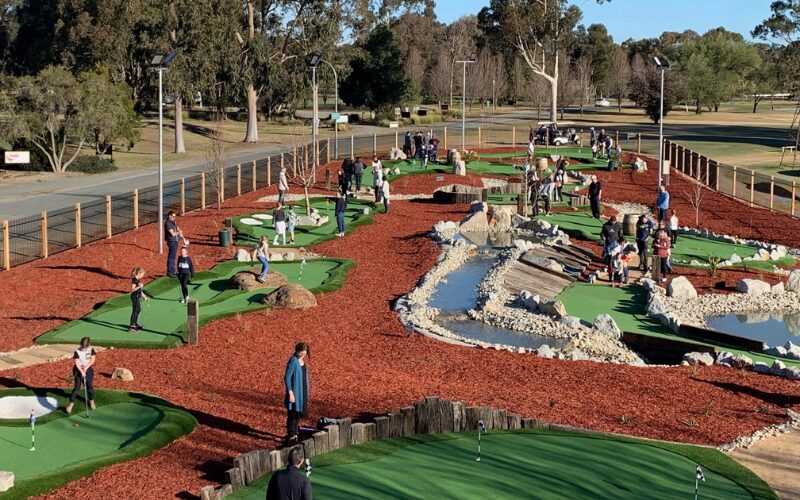
A mini golf course that looks great in photos but frustrates players, floods after rain, or deteriorates within a few seasons is a commercial liability. A course designed with care — with proper drainage, quality materials, considered hole layouts, and landscaping that reflects the setting — is an asset that generates revenue for decades.
In 2026, player expectations are higher than they have ever been. Families, couples and corporate groups are choosing venues based on the quality of the experience, not just the novelty of the activity. A course that was considered adequate five years ago will now feel dated to a market that has seen what quality looks like.
Getting the design right from the start is the single most important investment you can make. Everything else flows from it. You can read more about what players expect from a mini golf course in 2026 and what it means for venue operators planning a build.
Bespoke design for every site
No two mini golf courses built by Mini Golf Creations are the same. Every project begins with a thorough understanding of the site — its size, shape, topography, surrounding environment, and the commercial goals of the operator.
Whether you have an existing concept that needs expert execution, or you are starting with nothing more than a piece of land and an idea, the team works with you at every stage to develop a design that fits. That means taking into account the size and shape of the available land, the flow of players through the course, hole variety and challenge levels, theming and landscaping, drainage requirements, and integration with your broader venue offering.
The designs produced by Mini Golf Creations go well beyond the conventional. Significant time and thought is given to the planning stage precisely because the decisions made there determine the quality of everything that follows.
The mini golf course construction process: step by step
Understanding what is involved at each stage helps operators plan effectively and set realistic expectations for timeline and budget. Here is how a typical project unfolds.
Initial consultation. The process begins with a conversation — discussing your vision, goals, budget, and site possibilities with the Mini Golf Creations team to determine feasibility. This is the right time to ask questions, explore options, and get a clear sense of what is realistic for your location and investment level.
Site assessment. A thorough evaluation of the proposed location is conducted, considering terrain, space, accessibility, drainage characteristics, and any constraints that will affect the design. A site visit at this stage ensures that the concept developed in the next stage is grounded in the reality of the space.
Concept design. Working closely with the Mini Golf Creations design team, an initial concept is developed — covering layout, themes, obstacle types, and customer flow. This is where the vision starts to take shape. Locally relevant themes tend to perform well: Australian native landscapes, coastal environments, regional history, and outback settings all create a sense of place that generic themes cannot replicate.
Permits and approvals. Necessary approvals and permits are obtained from local councils and regulatory bodies to ensure compliance. The requirements vary by state and local government area, so it pays to work with a builder who understands the approvals landscape across Australia.
Final design and planning. Once the concept is approved, the design team finalises all course features, landscaping, and construction materials. Detailed documentation is produced including drawings of the course, contouring and earthworks plans, grassing plans, and drainage plans. Construction does not begin until you are fully satisfied with everything presented.
Budgeting and timeline. A clear budget and timeline for construction is established, ensuring everything aligns with your business goals and opening targets.
Construction. Mini Golf Creations’ experienced construction crew prepares the site, installs artificial turf, constructs obstacles, and implements drainage solutions. Every person on the team — from team leaders to the construction crew — is a golfer, which means they understand what it feels like to play a great hole and build accordingly.
Landscaping and theming. Finishing touches including plantings, pathways, lighting, and decorative elements are added to complete the experience. This stage is where the course comes to life and the sense of place is established.
Quality assurance and testing. The course is thoroughly tested to ensure playability, safety, and durability before opening. Nothing is signed off until the standard is right.
Grand opening. With the course complete, the focus shifts to launching and attracting your first visitors. Mini Golf Creations can advise on marketing strategies to support your opening and build momentum from day one.
To get a clearer picture of the full mini golf course design and process, the Mini Golf Creations website covers both stages in detail.
Indoor versus outdoor: which is right for your venue?
Both formats have genuine commercial merit, and the right choice depends on your location, climate, available space, and target audience.
Outdoor courses offer more space and a natural environment that lends itself to landscaping and locally themed design. They tend to feel more expansive and can accommodate larger groups comfortably. In most Australian climates, an outdoor course with thoughtful weather mitigation — shade sails, covered sections, quality drainage — will operate year-round without significant disruption.
Indoor courses offer all-weather operation, which is particularly valuable in regions with high rainfall or extreme summer heat. They also allow for controlled lighting environments, which opens up options for themed and glow-in-the-dark experiences that generate strong repeat visitation and event bookings. In urban settings where outdoor space is limited, an indoor format can make a project viable that would otherwise not be possible.
For venues considering a lower-commitment entry point before committing to a permanent build, pop-up mini golf is worth exploring. It is a practical way to test demand and revenue potential with an existing audience.
Materials: what works in the Australian climate?
Material selection has a direct impact on the long-term performance and maintenance costs of your course. Getting it right from the start avoids expensive repairs and replacements down the track.
Concrete bases are recommended for durability and to prevent sinking or movement over time. For turf, high-quality Australian-made and UV-stabilised synthetic grass is essential — cheaper imported alternatives deteriorate quickly in Australian conditions, particularly in regions with intense UV exposure. The right mini golf turf makes a significant difference to the longevity and playability of the course.
Drainage design is one of the most critical and most often underestimated elements of construction. A course that floods after heavy rain or develops pooling issues is not just inconvenient — it is lost revenue and a visitor experience problem. Proper drainage planning at the design stage prevents these issues entirely.
How much does it cost to build a mini golf course in Australia?
A commercial 18-hole mini golf course of high quality will typically start at $500,000, though costs vary considerably based on theme, complexity, site conditions, and finish quality. A 9-hole course or a more compact design will sit at a lower investment level.
What is consistent across all projects is that the return on investment is strong when the course is designed and built properly. Venues consistently report increased food and beverage sales, higher visit frequency, and stronger off-season performance once a quality course is operating. Detailed information on mini golf construction costs in Australia is available, along with a revenue calculator that lets you model projected returns based on your venue type and expected visitation.
Professional construction versus DIY
For a mini golf course that performs commercially, professional construction is the right approach. The technical elements of drainage, concrete shaping, and turf installation require expertise that directly affects how the course holds up over time and how it performs for players from day one.
A DIY build may appear to reduce upfront costs, but the risks — poor drainage, substandard materials, inadequate concrete bases — typically result in higher maintenance costs and lower visitor satisfaction over time. The long-term ROI of a professionally built course outperforms a DIY equivalent in almost every case.
Mini Golf Creations has built commercial mini golf courses across Australia for golf clubs, resorts, councils, holiday parks and private operators. Every project is approached with the same level of care and attention to detail, from the first site visit to opening day.
Ready to get started?
Whether you have a fully formed plan or are still in the early stages of exploring what is possible for your site, Mini Golf Creations is happy to talk it through. The team works with operators Australia-wide and internationally.
📞 +61 7 3823 2009 | minigolfcreations.com/contact-us
Frequently Asked Questions
Make sure to plan a routine of debris removal, turf grooming, obstacle repair, and regular deep cleaning. Because most modern courses rely on synthetic turf, daily and seasonal upkeep is straightforward but essential to protect your investment and preserve playability.
Prioritise playability over frustration. You might provide multi-level tee boxes for different skill levels, utilise interactive trick shots, or design a non-linear layout so groups can start at different holes to prevent queuing.
A standard 18-hole commercial mini golf course requires between 1,500 and 2,000 square metres. This ensures comfortable player flow, accessible pathways, and safety buffers between holes. Space must also allow for bathrooms and a pro shop.
Combine classic structural elements (ramps, loops, and tunnels) with a fun, overarching theme. You can design engaging features for your course by repurposing everyday items or building creative, physical structures that force players to adjust their putting strategy.
