- April 23, 2026
- Construction,Courses,Design,Mini Golf,Opportunities,
- Tracey
Last Updated: May 2026
The experience economy has fundamentally changed what players expect when they walk onto a mini golf course, and venues that understand the shift are pulling well ahead of those that haven’t caught up.
Five years ago, a clean course, working obstacles, and decent turf was enough to keep visitors happy. In 2026, that is no longer the benchmark — it is the minimum. In this blog, we’ll tell you about what players expect in 2026 so you can set up your business for success.
What Mini Golf Businesses Need to Know:
- Across hospitality, leisure, and entertainment, Australians are increasingly choosing experiences over products, and within those experiences, they are choosing quality over convenience.
- Players arrive with higher expectations, more discerning taste, and a much clearer sense of what a quality experience looks and feels like.
- Courses need to be professionally made for long-term ROI, which is where trusted specialists like Turf Green come in.
What the experience economy actually means for mini golf
The experience economy is not a marketing concept — it is a measurable shift in how consumers spend their money and what they expect in return.
Mini golf sits squarely in that shift. When it first gained popularity as a mass-market activity, novelty was enough. A spinning windmill, a loop-de-loop, a clown face — these were sufficient to draw a crowd because the activity itself was the novelty. That era has passed.
Today’s players arrive at a mini golf course having seen beautifully designed, immersive international venues on social media. Meeting those expectations is not optional for venues that want strong repeat visitation and word-of-mouth growth.
What players actually expect in 2026
A course that challenges them.
The rise of experienced recreational players means that courses which can be completed without any real effort will not generate repeat visits. Today’s players want holes that reward skill, offer multiple lines of play, and feel genuinely satisfying to complete. This does not mean the course needs to be difficult for beginners — but it does need layers of challenge that give experienced players a reason to come back and try to improve their score.
Design that is worth sharing.
Social media has become one of the most powerful drivers of mini golf visitation, and venues that understand this design for it deliberately. A hole with a spectacular water feature, a tunnel under a bridge, or a creative elevation change is not just a fun obstacle — it is a shareable moment. Venues that create those moments benefit from organic social promotion that no marketing budget can fully replicate. For a deeper look at how design drives repeat visits, our 10 mini golf course design tips cover this in detail.
Landscaping and finish quality that reflects the setting.
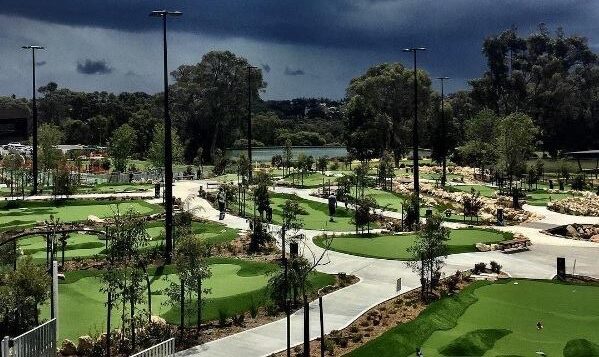
Players notice when a course feels like it belongs in its environment. Coastal courses that echo the landscape around them, bushland courses with natural materials and native plantings, resort courses that complement the broader venue aesthetic — these create a sense of place that elevates the entire experience. Generic theming, by contrast, communicates to players that the venue did not invest in the detail.
A seamless venue experience.
Mini golf in 2026 rarely exists in isolation. Players expect the course to be integrated with food and beverage, comfortable seating, clean facilities, and a venue that feels cohesive. A beautifully designed course next to a tired café or poor amenities will underperform, because the experience is judged as a whole. Operators who think carefully about the full visitor journey — arrival, play, post-round food and drink, departure — outperform those who focus on the course alone.
Technology where it adds value.
Digital scoring, app-connected experiences, and interactive elements are increasingly common at leading venues internationally and are beginning to appear across Australia. The key word is “adds value” — technology that genuinely enhances the experience is welcomed by players, while technology that feels gimmicky or creates friction is not. For most venues, the priority should be nailing the fundamentals of design and landscaping first, with technology layered in where it serves the experience rather than replacing it.
The social dimension has grown significantly
Mini golf has always been a social activity, but the social dimension has grown considerably in recent years. Birthday parties, corporate team building, date nights, and group outings now account for a meaningful share of mini golf revenue at well-run venues. Each of those use cases has specific expectations attached to it.
Corporate groups want a venue that reflects well on the organiser — one that feels premium, is easy to book for groups, and comes with food and beverage options that work for a professional context. Birthday parties want flexibility, a venue that is visually appealing in photographs, and staff who understand how to run a group efficiently. Date night visitors want something that feels like it was designed for the occasion rather than an afterthought.
Venues that design for these use cases — and market to them deliberately — generate significantly higher revenue per square metre than those that focus only on casual family visits. Our guide to creating a profitable mini golf event venue goes deeper on this.
What does this mean if you are building or renovating?
If you are planning a new mini golf course or considering a renovation, the experience economy shift has direct implications for how you approach the project.
Building to the minimum standard is a commercial risk. A course that was considered adequate five years ago will now feel dated to a market that has seen what quality looks like. The venues opening in 2026 are setting a new benchmark, and new builds that do not meet that benchmark will find it harder to drive the repeat visitation and word-of-mouth that make mini golf commercially viable long-term.
This does not mean the investment needs to be extravagant. It means the investment needs to be deliberate — focused on design quality, materials that hold up over time, landscaping that creates a sense of place, and a layout that gives players a genuine reason to return.
The World Minigolf Sport Federation — the global governing body for the sport — tracks participation trends internationally and consistently points to experience quality as the primary driver of repeat visitation across markets.
At Mini Golf Creations, every course we design starts with the question of what will make players want to come back. If you are thinking about a new build or renovation and want to understand what the current standard looks like, we are happy to walk you through it.
📞 +61 7 3823 2009 | minigolfcreations.com/contact-us
Frequently Asked Questions
Players are much more focused on entertainment over serious competition, but merge the two into competitive socialising. Rather than focusing purely on scores, players view the sport as an engaging social backdrop where food, drinks, technology, and photo-sharing are as important as the actual putting.
Rather than following theme trends, which change quickly, focus on the quality and modernity of your course. Include immersive, sensory, storytelling details, with high-quality aesthetics prioritised over gimmicks.
Operators are attracting eco-conscious players by installing solar-powered lighting, eliminating single-use plastics, and highlighting circular economy principles. Outdoor courses flow with the natural landscape around them, highlighting native plants.
