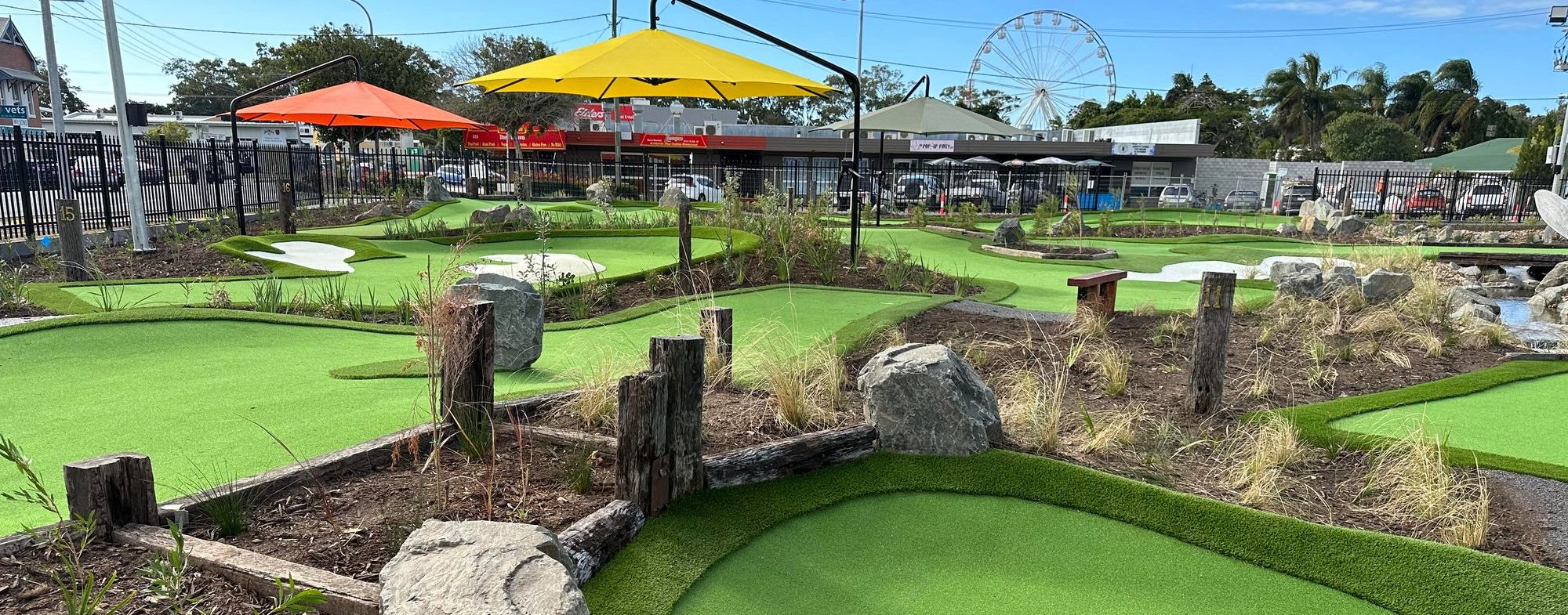
Mini golf has quietly become one of the smartest commercial investments available to venue operators in Australia. Golf clubs, holiday parks, councils and private developers are adding courses not as a novelty — but as a genuine, long-term revenue stream that pays for itself and keeps delivering.
If you’re exploring mini golf as a business idea, here’s what the opportunity actually looks like in 2026.
Is mini golf a good business in Australia?
The numbers say yes. According to Golf Australia’s 2023 Participation Report, over 2 million Australians now play off-course golf — a category that includes mini golf alongside driving ranges. That’s a large, growing audience actively looking for accessible, social, family-friendly experiences.
What makes mini golf particularly attractive as a business is its broad appeal. It doesn’t require a specific skill level, age group, or budget. Families, couples, corporate groups, school excursions and grey nomads can all play — and enjoy it. That inclusivity translates directly into consistent foot traffic across seasons and demographics.
As Geoff Bennell, founder of Mini Golf Creations, puts it: “People are using mini golf to build a place where they can eat, drink and have fun.” That’s the real business model — mini golf as the anchor that drives broader venue spend.
What kind of venues are adding mini golf?
The range of operators investing in mini golf right now is broader than most people expect.
Golf clubs and resorts are using it to attract non-golfers — partners, children and younger visitors who wouldn’t otherwise engage with the venue. A well-designed course extends the club’s appeal without compromising its existing offering.
Holiday parks and caravan parks are finding mini golf drives bookings and repeat stays. Families choose parks with more on-site activities, and mini golf is one of the most universally enjoyed. It fills afternoons, keeps kids engaged and gives parents a reason to stay put rather than drive elsewhere.
Local councils and regional operators are investing in mini golf as part of tourism infrastructure. A quality course gives visitors a reason to extend their stay, fills the off-season calendar, and generates economic activity that flows through to local accommodation, food and retail.
Private developers and entertainment venues are building standalone mini golf experiences or integrating courses into broader family entertainment centres — combining mini golf with food and beverage, arcade games and events spaces to create a full-day destination.
Each of these models works. The right approach depends on your site, your existing offering and your revenue goals.
What does the revenue model look like?
Mini golf generates income in several ways, not just ticket sales.
The primary revenue stream is green fees — typically charged per person per round. Pricing varies by venue type and location, but Australian courses generally charge between $12 and $22 per adult and $8 to $15 per child.
The secondary revenue streams are often just as significant. Mini golf drives:
- Increased food and beverage spend — players stay longer and spend more at the café, bar or restaurant
- Private bookings and events — birthday parties, corporate team-building, school groups and community events
- Seasonal programming — themed nights, glow golf events, holiday activations
- Membership or loyalty programs for high-frequency local visitors
When you add those streams together, the commercial case becomes compelling. Mini Golf Creations offers a revenue calculator that lets you model projected returns based on your venue type and expected visitation — a useful starting point before committing to a build.
How long does it take to see a return on investment?
This varies depending on the scale of the investment and the volume of visitors your venue attracts. However, well-designed courses in high-traffic locations typically begin generating strong returns within the first two to three years of operation.
The key factors that affect ROI are design quality, location, marketing and integration with your existing venue offering. A course that’s bolted on as an afterthought will underperform. A course that’s designed as a genuine centrepiece — with good flow, strong theming and proper integration with food and beverage — will outperform expectations.
You can read more about how to increase mini golf course profit year-round here.
What does it cost to start a mini golf business in Australia?
Construction costs vary based on size, complexity, site conditions and finish quality. A compact 9-hole course sits at a different investment level to a fully landscaped, themed 18-hole facility.
What’s consistent is that mini golf remains one of the more accessible leisure attractions to build and operate. Compared to a waterpark, climbing centre or large-scale entertainment facility, the capital requirement is relatively modest — and the ongoing maintenance costs are low once the course is built properly from the start.
Detailed information on mini golf construction costs in Australia is available on the Mini Golf Creations website, along with guidance on what to budget for different venue types and scales.
What makes mini golf recession-resilient?
One of the less-discussed strengths of mini golf as a business is its performance during economic downturns. When household budgets tighten, families look for affordable, local entertainment options rather than expensive holidays or outings. Mini golf fits that profile almost perfectly — it’s low cost, close to home, and delivers genuine enjoyment.
The International Association of Miniature Golf consistently points to mini golf’s resilience as a leisure category globally, noting that participation holds steady or grows during periods of economic uncertainty. For venue operators looking for a stable, long-term investment, that’s a meaningful consideration.
How do you get started?
The first step is understanding what’s possible for your specific site and venue type. Mini Golf Creations works with operators across Australia and internationally — from initial feasibility conversations through to design, construction and opening day.
Whether you have a fully formed plan or just an idea worth exploring, the team is happy to talk it through.