- March 27, 2026
- Construction,Courses,Design,Mini Golf,
- Tracey
If you’re considering adding a mini golf course to your venue, you’re not alone. Golf clubs, councils, holiday parks and private developers across Australia are investing in mini golf at a rate not seen before. And the reasons are straightforward — it works commercially, it appeals to everyone, and when it’s designed well, it pays for itself.
But design is everything. A poorly planned course frustrates players, costs more to maintain, and underperforms from day one. A well-designed course becomes an asset that generates revenue for decades.
Here’s what you need to understand before you build.
What makes a good mini golf course design?
Good mini golf course design balances three things: playability, commercial performance, and place.
Playability means the course is genuinely enjoyable for every skill level — from a five-year-old on their first visit to an experienced golfer looking for a real challenge. The best courses offer multiple ways to play each hole, so nobody feels locked out of the fun.
Commercial performance means the layout works for your business. That includes efficient flow so groups don’t back up, easy supervision with minimal staffing, and a design that encourages repeat visits rather than a one-and-done experience.
Place means the course feels like it belongs where it’s built. A coastal course in Queensland should feel different to one built in the Victorian high country or at a resort in the Whitsundays. Custom landscaping, local materials, and thoughtful theming are what separate a memorable course from a generic one.
At Mini Golf Creations, every course starts with a detailed site assessment and design process that considers all three. No two courses are the same.
How much space do you actually need?
One of the most common questions from venue operators is around footprint. The good news is that mini golf is more flexible than most people assume.
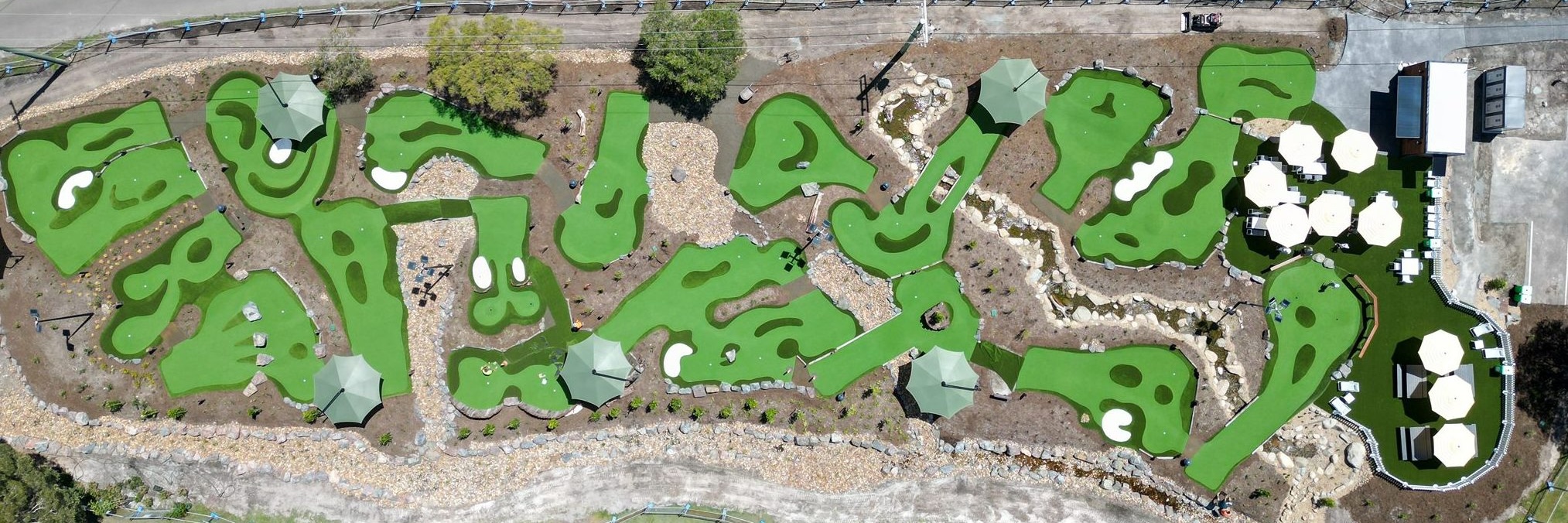
A standard 18-hole commercial course typically requires around 2,000–2,500 square metres. But compact urban designs and 9-hole formats can work in much smaller footprints — as little as 500–800 square metres for the right layout.
Holiday parks, golf clubs with unused land, council showgrounds, and resort precincts often have more viable space than they realise. The key is working with a designer who can assess the site properly rather than applying a one-size-fits-all template.
For venues with tighter spaces, pop-up mini golf is also worth considering — a lower-commitment way to test the concept before committing to a permanent build.
What does mini golf course construction actually involve?
Construction typically takes between 14 and 20 weeks from design sign-off to opening day. The process covers site preparation, base construction, turf installation, obstacle and feature builds, landscaping, and finishing.
The quality of materials matters enormously for long-term performance. Synthetic turf selection, drainage design, and the durability of obstacles all affect how the course holds up over time — particularly in Australia’s variable climate, from tropical north Queensland to cold southern winters.
You can read more about weather-resilient course design here — it’s one of the most overlooked aspects of the planning process.
Who is building mini golf courses in Australia right now?
The short answer: a wide range of operators.
Golf clubs are adding mini golf to attract non-golfer family members and younger audiences who wouldn’t otherwise visit. Resorts are using it to increase on-property dwell time and reduce the need for guests to leave the venue. Regional councils are investing in mini golf as part of broader tourism infrastructure — giving visitors a reason to stay longer and spend more locally. Holiday parks are finding it drives bookings and repeat stays, particularly during school holidays.
According to Golf Australia’s 2023 Participation Report, over 2 million Australians now play off-course golf — a figure that includes mini golf alongside driving ranges. That’s a large and growing audience that operators are increasingly competing to attract.
For a deeper look at the commercial case, the International Association of Miniature Golf tracks participation trends globally and consistently points to mini golf’s resilience as a leisure category even during economic downturns.
What does it cost to build a mini golf course in Australia?
Cost varies considerably based on scale, complexity, site conditions and finish quality. A basic 9-hole course will sit at a different price point to a fully landscaped, themed 18-hole facility.
What’s consistent across all projects is that the return on investment is strong when the course is designed properly. Venues report increased food and beverage sales, higher visit frequency, and stronger off-season performance once a quality course is in place.
Mini Golf Creations publishes detailed information on mini golf construction costs as well as a revenue calculator that lets you model projected returns based on your venue type and expected visitation — a useful starting point before any formal conversations.
Should you renovate an existing course or start fresh?
If you already have a mini golf course that’s underperforming, the answer isn’t always to demolish and rebuild. In many cases, a targeted renovation — new turf, updated obstacles, improved landscaping — can transform the player experience at a fraction of the cost of a new build.
The tell-tale signs a course needs attention: worn or patchy turf, obstacles that no longer function properly, a layout that feels dated, and declining repeat visitation. If any of those sound familiar, it’s worth getting an assessment done.
More on when to renovate versus rebuild here.
Getting started
The best first step is a conversation. Mini Golf Creations works with golf clubs, councils, holiday parks, resorts and private developers across Australia and internationally — from initial concept through to opening day.
If you have a site in mind, or even just an idea you want to test, get in touch with the team directly.
